March 10

03-10
Southdown Soup
Crisp Crackers
*Cadillac Chicken
Creamed Sweet Potatoes
Escalloped Corn
Praline Ice Cream
Sponge Drops

In 1914 March 10 was a Tuesday.

Southdown Soup is a lamb broth with green beans and rice. Southdown is a breed of sheep, so I’m presuming that’s to what the name refers.

To dress a chicken for broiling, Fannie Farmer says “Singe, wipe, and with a sharp-pointed knife, beginning at back of neck, make a cut through backbone the entire length of bird. Lay open the bird and remove contents from inside. Cut out rib bones on either side of backbone, remove from breastbone, then cut through tendons at joints.” In other words, spatchcock it. It will lay flat and cook more evenly.

M2This project is supported by my Patrons on Patreon and donations from other enthusiasts of historic cookery. With your help I can acquire the unusual ingredients and equipment and do the research needed to continue my culinary adventures. Thank you so much!

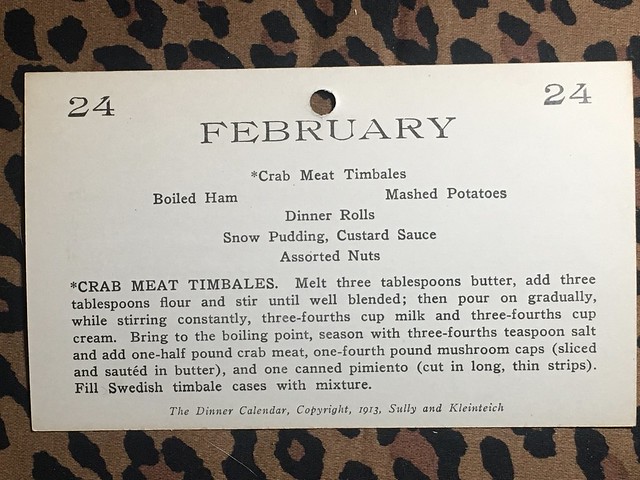
February 24

02-24
*Crab Meat Timbales
Boiled Ham
Mashed Potatoes
Dinner Rolls
Snow Pudding, Custard Sauce
Assorted Nuts

In 1914 February 24 was a Tuesday. It’s also Shrove Tuesday (aka Mardi Gras aka the last day before Lent), but I don’t see that reflected in the menu.

Timbales are deep-fried pastry shells made by dipping a heated form (a timbale iron) in batter and then in hot fat. The resultant timbale cases are filled, in this case with creamed crab and mushrooms. One can still get timbale (and rosette) irons from Nordic Ware*. (And perhaps some day I shall…)

*I have no affiliation with Nordic Ware other than being a satisfied user of their bakeware.

M2This project is supported by my Patrons on Patreon and donations from other enthusiasts of historic cookery. With your help I can acquire the unusual ingredients and equipment and do the research needed to continue my culinary adventures. Thank you so much!

February 17

02-17
Cream of Pea Soup
Crisp Crackers
Boiled Mutton
Caper Sauce
Mashed Sweet Potatoes
*Parched Rice, Tomato Sauce
French Fruit Pudding, Wine Sauce

In 1914 February 17 was a Tuesday.

The French Fruit Pudding is attributed to Mrs. Carrie M. Dearborn. She was the principal of The Boston Cooking School when Fannie Farmer was a student. Miss Farmer became her assistance principal in 1889 and succeeded her as principal after Mrs. Dearborn’s death in 1891.  But what makes this fruit pudding French?

M2This project is supported by my Patrons on Patreon and donations from other enthusiasts of historic cookery. With your help I can acquire the unusual ingredients and equipment and do the research needed to continue my culinary adventures. Thank you so much!

February 10

02-10
Onion Soup
Roast Spare Ribs, Brown Gravy
Apple Cups
Savory Potatoes
Turnip Cones
*Coupe Moquin
Walnut Wafers

In 1914 February 10 was a Tuesday.

Apple Cups are hollowed-out apples, but usually there’s something to put in them, like salad. There’s no indication what might be in these apple cups.

Coupe Moquin is probably named for restauranteur Henri Mouquin.

For the Walnut Wafers we’re using the Almond Wafer recipe and changing out the nuts.

M2This project is supported by my Patrons on Patreon and donations from other enthusiasts of historic cookery. With your help I can acquire the unusual ingredients and equipment and do the research needed to continue my culinary adventures. Thank you so much!


February 3

02-03

*Fried Salt Pork, Country Style
Buttered Beets
Radishes
Grape Fruit Salad, French Dressing
Cheese Wafers
Spanish Cream

In 1914 February 3 was a Tuesday.

What makes the cream Spanish? I’m still looking for answers.

I tried the Fried Salt Pork! Mostly because some folks were asking about it and I happened to have some leftover salt pork in the freezer from making Miss Daniel’s Meat Loaf.

M2This project is supported by my Patrons on Patreon and donations from other enthusiasts of historic cookery. With your help I can acquire the unusual ingredients and equipment and do the research needed to continue my culinary adventures. Thank you so much!

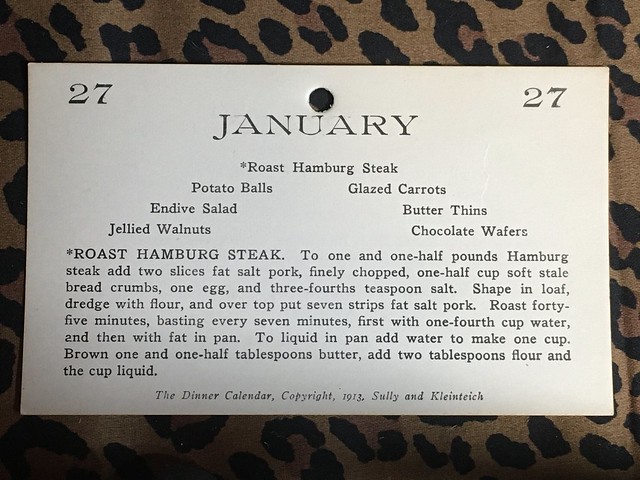
January 27

01-27

*Roast Hamburg Steak
Potato Balls
Glazed Carrots
Endive Salad
Butter Thins
Jellied Walnuts
Chocolate Wafers

.In 1914 January 27 was a Tuesday.

Roast Hamburg Steak is basically meatloaf.

Butter Thins were a brand of cracker made by the Johnson Educator Biscuit Company, a cracker company in Boston.

M2This project is supported by my Patrons on Patreon and donations from other enthusiasts of historic cookery. With your help I can acquire the unusual ingredients and equipment and do the research needed to continue my culinary adventures. Thank you so much!

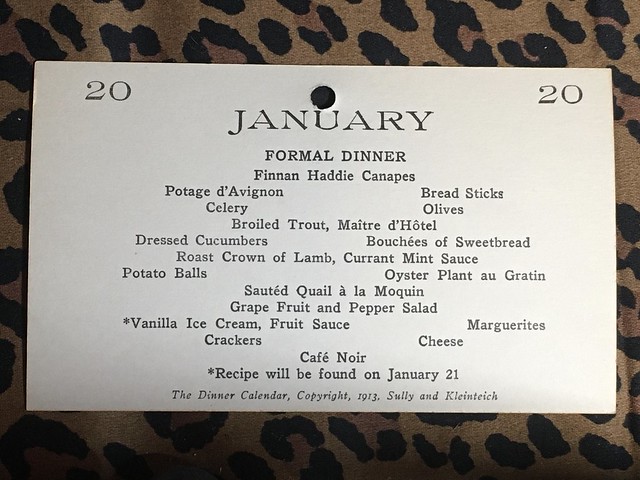
January 20, Formal Dinner

01-20
Finnan Haddie Canapés
Potage d’Avignon
Bread Sticks
Celery
Olives
Broiled Trout, Maître d’Hôtel
Dressed Cucumbers
Bouchées of Sweetbread
Roast Crown of Lamb, Currant Mint Sauce
Potato Balls
Oyster Plant au Gratin
Sautéd Quail à la Moquin
Grape Fruit and Pepper Salad
*Vanilla Ice Cream, Fruit Sauce
Marguerites
Crackers
Cheese
Café Noir

In 1914 January 20 was a Tuesday. Why are we having a formal dinner on Tuesday? It’s my sister’s birthday and that’s a good enough reason for me.

There is a lot going on in this meal…

Finnan Haddie is cold-smoked haddock. Our local butcher shop carries it, so I should give it a try.

Bouchées are small pastry cases.

The Potato Balls are shaped with a French vegetable cutter. They were used to cut fruits and vegetables into ball shapes, but I have yet to find an image of one, let alone an actual cutter. Let me know if you’ve ever seen one!

Oyster Plant is a common name for salsify and according to Fannie Farmer “Oyster plant is in season from October to March.” I haven’t found a recipe for Oyster Plant au Gratin, but you could probably make Potatoes au Gratin and substitute salsify root. Fannie Farmer says to cook it so: “Wash, scrape, and put at once into cold acidulated water to prevent discoloration. Cut in inch slices, cook in boiling salted water until soft, drain”.

Quail à la Moquin is presumably named after restauranteur Henri Mouquin. Mouquin came to New York from Switzerland, via Paris, and began his career as a waiter at the famed Delmonico’s. Mouquin opened three restaurants in New York, with his wife, Marie Granjean as chef. She is credited with introducing French onion soup to the United States.

There are two recipes for Marguerites in The Boston Cookery-School Cook Book. Both look like sweet little treats. One is a pastry and the other is more like divinity, but baked on saltines!

M2This project is supported by my Patrons on Patreon and donations from other enthusiasts of historic cookery. With your help I can acquire the unusual ingredients and equipment and do the research needed to continue my culinary adventures. Thank you so much!

January 13

01-13
Royal Soup
Imperial Sticks
Breaded Lamb Chops, Tomato Sauce
*Baked Potatoes, Hotel Style
Moulded Spinach
Wafer Crackers
Cream Cheese
Bar-le-duc Strawberries
Café Noir

In 1914 January 13 was a Tuesday.

Royal Soup with Imperial Sticks sounds so grand! The reality is a very frugal soup with toasted stale bread.

I found a recipe for Breaded Mutton Chops, but not lamb. It should work about the same, maybe with a shortened cooking time.

Bar-le-Duc strawberries are a kind of preserve. The town is famous for their currant preserves, in which the ripe currants are hand-seeded using a goose quill, leaving the fruit intact, like little pearls or caviar. I’m told that they pop delightfully in your mouth, but I haven’t been lucky enough to taste it. I also haven’t found much information about the strawberry version, but I assume it was just as delicious and just as much of a status symbol.

UPDATE: Canning, Preserving and Pickling by Marion Harris Neil (1914) has a recipe!

STRAWBERRY BAR-LE-DUC, p. 124
Perfect strawberries. Sugar.
Three things are indispensable in making strawberry bar-le-duc. The first is strong, steady sunshine, the second, hot platters or plates, the third plenty of window-glass.
The fruit should be of good flavor, the sugar pure. To every pound of fruit allow three cupfuls of sugar. Heat the sugar on plates in the oven, taking care not to let it melt or get too brown. It should be as hot as possible without melting.
Spread a thin layer of hot sugar over the bottoms of hot platters or deep plates, then a layer of fruit and then another layer of sugar.
Cover the platters with a clean sheet of window-glass and place outdoors in the hot sun or in a sunny window. If the fruit is outdoors it must be brought in when the sun sets and put in a dry place indoors.
Return to the sun in the morning. In a few days the fruit will grow plump and firm and the syrup almost a jelly.
Pack in tumblers and seal.
If the syrup is not thick, boil until clear and thickened, then pour in the glasses over the fruit.

M2This project is supported by my Patrons on Patreon and donations from other enthusiasts of historic cookery. With your help I can acquire the unusual ingredients and equipment and do the research needed in my quest for greater historical accuracy in my culinary adventures. Thank you so much!

January 6

Celery Soup
Turkey Soufflé
Brussels Sprouts
*Deerfoot Potatoes
Steamed Cranberry Pudding
Creamy Sauce
Café Noir

In 1914 January 6 was a Tuesday.

The Turkey Soufflé is probably meant to use up the leftovers from the roast turkey on the 4th. I have not yet found a specific recipe for it, but presumably one could make Chicken Soufflé and substitute turkey.

Why Deerfoot Potatoes? Because the best sausages came from Deerfoot Farms in Southborough, Massachusetts! According to an ad in the New York Times in January 1914 they are “Made of the tender meat of dairy fed young porkers, daintily seasoned with selected spices.” Fannie Farmer frequently uses specific, and often local, brands in her recipes. 

M2This project is supported by my Patrons on Patreon and donations from other enthusiasts of historic cookery. With your help I can acquire the unusual ingredients and equipment and do the research needed in my quest for greater historical accuracy in my culinary adventures. Thank you so much!