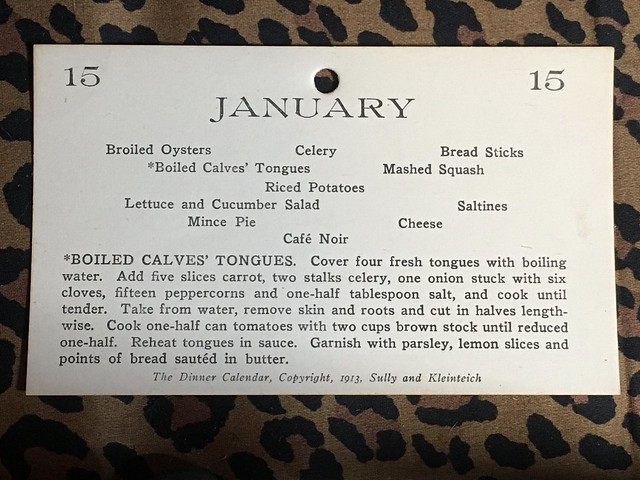
January 15

01-15

Broiled Oysters
Celery
Bread Sticks
*Boiled Calves’ Tongues
Mashed Squash
Riced Potatoes
Lettuce and Cucumber Salad
Saltines
Mince Pie
Cheese
Café Noir

In 1914 January 15 was a Thursday.

Ricing potatoes was a pretty common treatment at this time, which seems to have fallen out of favor. Does anyone use a ricer? I’ve got one on my wish list…

The lettuce and cucumber salad is deceptively simple, but the presentation is everything — alternating leaves of lettuce and slices of cucumber. 
A Chapon. Remove a small piece from end of French loaf and rub over with a clove of garlic, first dipped in salt. Place in bottom of salad bowl before arranging salad. A chapon is often used in vegetable salads, and gives an agreeable additional flavor.” (The Boston Cooking School Cook Book, p. 323)

M2This project is supported by my Patrons on Patreon and donations from other enthusiasts of historic cookery. With your help I can acquire the unusual ingredients and equipment and do the research needed to continue my culinary adventures. Thank you so much!

January 14

01-14
French Smelts, Sauce Tartare
Shredded Potatoes
French String Beans
*Fruit Salad, French Dressing
Mosaic Sandwiches
Apple Pie
Cheese Slices
Café Noir

In 1914 January 14 was a Wednesday.

The fruit salad is served with a vinaigrette, so consider it the salad course and not a dessert.

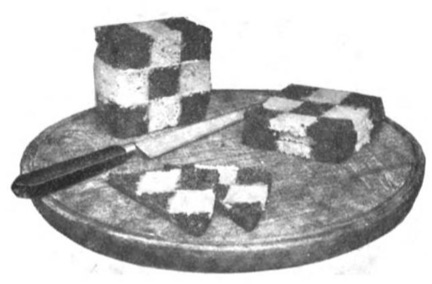
Mosaic Sandwiches are just bread and butter sandwiches, but with two colors of bread cut and assembled to form a checkerboard pattern.
Mosaic SandwichesPhoto from A New Book of Cookery (1912).

Apple pie with cheese is a pretty common New England treat. I think it’s best with a sharp cheddar.

M2This project is supported by my Patrons on Patreon and donations from other enthusiasts of historic cookery. With your help I can acquire the unusual ingredients and equipment and do the research needed to continue my culinary adventures. Thank you so much!

January 13

01-13
Royal Soup
Imperial Sticks
Breaded Lamb Chops, Tomato Sauce
*Baked Potatoes, Hotel Style
Moulded Spinach
Wafer Crackers
Cream Cheese
Bar-le-duc Strawberries
Café Noir

In 1914 January 13 was a Tuesday.

Royal Soup with Imperial Sticks sounds so grand! The reality is a very frugal soup with toasted stale bread.

I found a recipe for Breaded Mutton Chops, but not lamb. It should work about the same, maybe with a shortened cooking time.

Bar-le-Duc strawberries are a kind of preserve. The town is famous for their currant preserves, in which the ripe currants are hand-seeded using a goose quill, leaving the fruit intact, like little pearls or caviar. I’m told that they pop delightfully in your mouth, but I haven’t been lucky enough to taste it. I also haven’t found much information about the strawberry version, but I assume it was just as delicious and just as much of a status symbol.

UPDATE: Canning, Preserving and Pickling by Marion Harris Neil (1914) has a recipe!

STRAWBERRY BAR-LE-DUC, p. 124
Perfect strawberries. Sugar.
Three things are indispensable in making strawberry bar-le-duc. The first is strong, steady sunshine, the second, hot platters or plates, the third plenty of window-glass.
The fruit should be of good flavor, the sugar pure. To every pound of fruit allow three cupfuls of sugar. Heat the sugar on plates in the oven, taking care not to let it melt or get too brown. It should be as hot as possible without melting.
Spread a thin layer of hot sugar over the bottoms of hot platters or deep plates, then a layer of fruit and then another layer of sugar.
Cover the platters with a clean sheet of window-glass and place outdoors in the hot sun or in a sunny window. If the fruit is outdoors it must be brought in when the sun sets and put in a dry place indoors.
Return to the sun in the morning. In a few days the fruit will grow plump and firm and the syrup almost a jelly.
Pack in tumblers and seal.
If the syrup is not thick, boil until clear and thickened, then pour in the glasses over the fruit.

M2This project is supported by my Patrons on Patreon and donations from other enthusiasts of historic cookery. With your help I can acquire the unusual ingredients and equipment and do the research needed in my quest for greater historical accuracy in my culinary adventures. Thank you so much!
January 12

01-12
Swiss Potato Soup
Broiled Porterhouse Steak
French Fried Potatoes
Creamed Cauliflower
*Dresden Sandwiches, Sherry Sauce

In 1914 January 12 was a Monday.

Dresden Sandwiches are French toast sandwiches with jam filling.

M2This project is supported by my Patrons on Patreon and donations from other enthusiasts of historic cookery. With your help I can acquire the unusual ingredients and equipment and do the research needed in my quest for greater historical accuracy in my culinary adventures. Thank you so much!
January 11

01-11
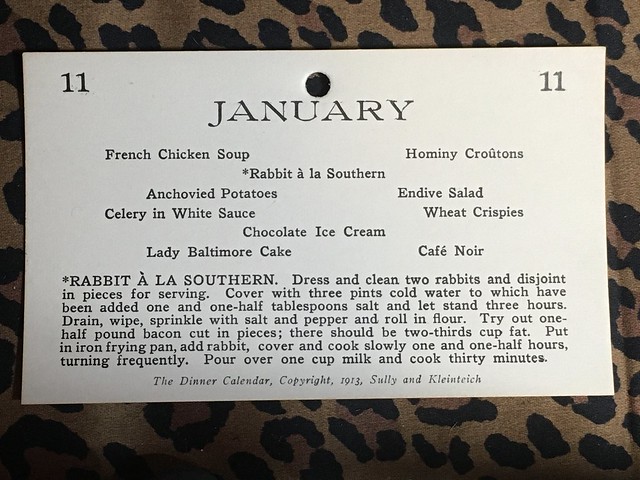
French Chicken Soup
Hominy Croûtons
*Rabbit à la Southern
Anchovied Potatoes
Endive Salad
Celery in White Sauce
Wheat Crispies
Chocolate Ice Cream
Lady Baltimore Cake
Café Noir

In 1914 January 11 was a Sunday.

Wheat Crispies are a brand of cracker made by O. B. Gilman, a Boston bakery.

The chocolate ice cream calls for squares of Baker’s chocolate. This is a brand of unsweetened chocolate still available today, originally made in a factory in Boston, right down the road from me (it’s luxury apartments now).  In Fannie’s the unsweetened chocolate came in individually wrapped squares, each weighing one ounce. Now the chocolate comes in bars, but it’s easy enough to convert squares to ounces.

M2This project is supported by my Patrons on Patreon and donations from other enthusiasts of historic cookery. With your help I can acquire the unusual ingredients and equipment and do the research needed in my quest for greater historical accuracy in my culinary adventures. Thank you so much!

January 10

01-10

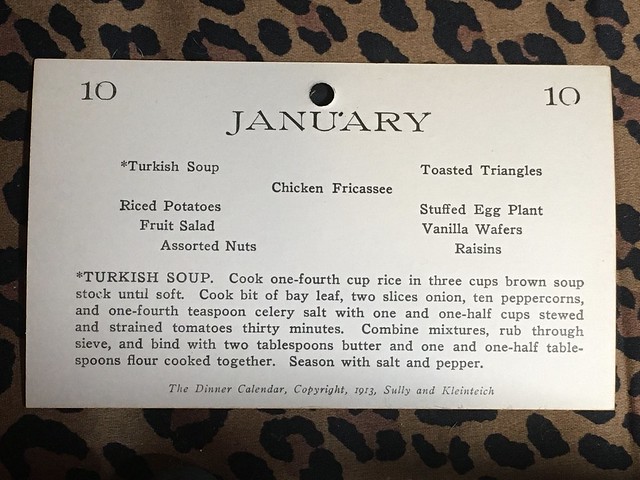
*Turkish Soup
Toasted Triangles
Chicken Fricassee
Riced Potatoes
Stuffed Egg Plant
Fruit Salad
Vanilla Wafers
Assorted Nuts
Raisins

In 1914 January 10 was a Saturday. 

There are recipes for fruit salads served as salads and fruits salads served as desserts. I’m assuming this one is a dessert fruit salad as it’s positioned opposite the vanilla wafers.

M2This project is supported by my Patrons on Patreon and donations from other enthusiasts of historic cookery. With your help I can acquire the unusual ingredients and equipment and do the research needed in my quest for greater historical accuracy in my culinary adventures. Thank you so much!

January 9

01-09

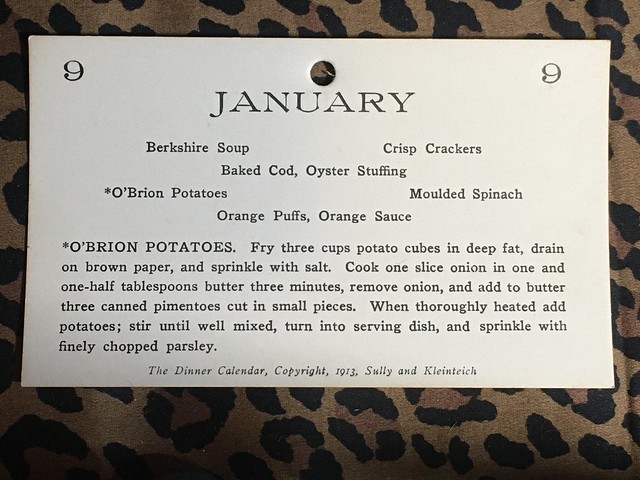
Berkshire Soup
Crisp Crackers
Baked Cod, Oyster Stuffing
*O’Brion Potatoes
Moulded Spinach
Orange Puffs, Orange Sauce

In 1914 January 9 was a Friday. And we’ve got fish again!

I presume Berkshire Soup is named for the picturesque region in Western Massachusetts and not the county in England.

O’Brion Potatoes (usually spelled O’Brien) might have originated in Boston at the turn of the 20th century, or maybe New York. One more thing for the two cities to squabble over… The recipe usually calls for bell peppers, but here it’s canned pimientos. 

M2This project is supported by my Patrons on Patreon and donations from other enthusiasts of historic cookery. With your help I can acquire the unusual ingredients and equipment and do the research needed in my quest for greater historical accuracy in my culinary adventures. Thank you so much!

January 8

01-08

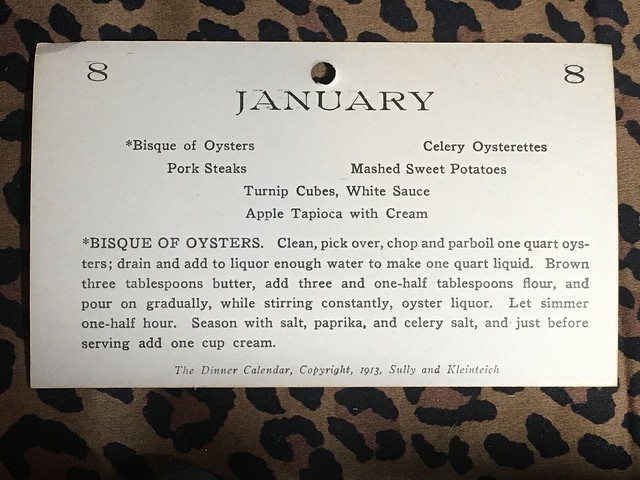
*Bisque of Oysters
Celery Oysterettes
Pork Steaks
Mashed Sweet Potatoes
Turnip Cubes, White Sauce
Apple Tapioca with Cream

In 1914 January 8 was a Thursday.

Oysterettes were a brand of oyster cracker. I have yet to find anything that shows that they were available in celery flavor. Let me know if you do!

Note from 2023: I’m pretty convinced that there was a typesetting error and that Celery and Oysterettes are two separate items. Thanksgiving Dinner No. 1 from What to Have for Dinner has a first course of Oyster Stew and Celery and Oyster Crackers.

M2This project is supported by my Patrons on Patreon and donations from other enthusiasts of historic cookery. With your help I can acquire the unusual ingredients and equipment and do the research needed in my quest for greater historical accuracy in my culinary adventures. Thank you so much!

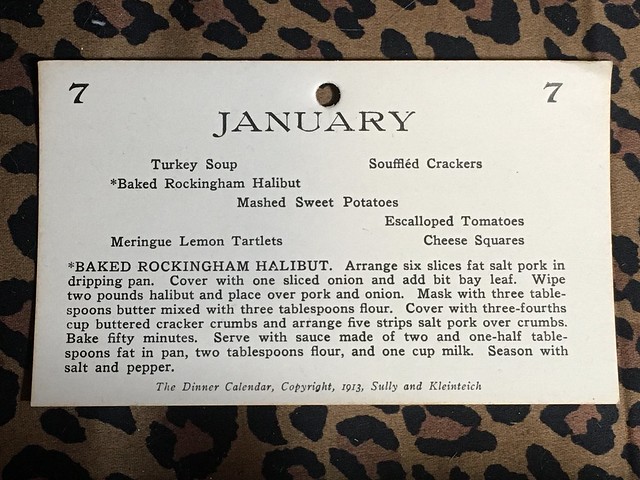
January 7

01-07
Turkey Soup
Souffléd Crackers
*Baked Rockingham Halibut
Mashed Sweet Potatoes
Escalloped Tomatoes
Meringue Lemon Tartlets
Cheese Squares

In 1914 January 7 was a Wednesday.

The turkey carcass from the 4th now becomes soup.

Souffléd Crackers are made with common crackers, a large round cracker, slightly puffed, like an oyster cracker, so they could be split easily. They’re very plain and much improved by toasting, serving with cheese, or crumbling into chowder. One of the bakeries that made them (as well as hardtack and other durable crackers) is just down the road from me.

M2This project is supported by my Patrons on Patreon and donations from other enthusiasts of historic cookery. With your help I can acquire the unusual ingredients and equipment and do the research needed in my quest for greater historical accuracy in my culinary adventures. Thank you so much!

January 6

Celery Soup
Turkey Soufflé
Brussels Sprouts
*Deerfoot Potatoes
Steamed Cranberry Pudding
Creamy Sauce
Café Noir

In 1914 January 6 was a Tuesday.

The Turkey Soufflé is probably meant to use up the leftovers from the roast turkey on the 4th. I have not yet found a specific recipe for it, but presumably one could make Chicken Soufflé and substitute turkey.

Why Deerfoot Potatoes? Because the best sausages came from Deerfoot Farms in Southborough, Massachusetts! According to an ad in the New York Times in January 1914 they are “Made of the tender meat of dairy fed young porkers, daintily seasoned with selected spices.” Fannie Farmer frequently uses specific, and often local, brands in her recipes. 

M2This project is supported by my Patrons on Patreon and donations from other enthusiasts of historic cookery. With your help I can acquire the unusual ingredients and equipment and do the research needed in my quest for greater historical accuracy in my culinary adventures. Thank you so much!